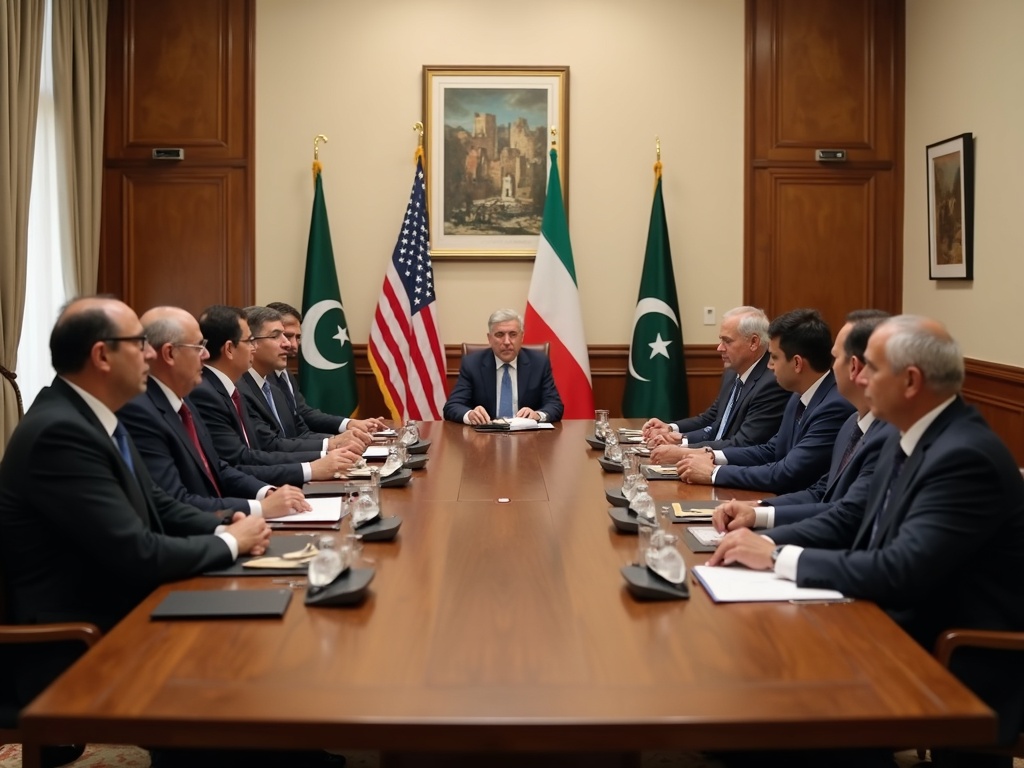
- Prime Minister Shehbaz Sharif confirmed “full efforts” are underway to resolve outstanding issues following direct US-Iran talks in Islamabad.
- The Prime Minister described the Islamabad Talks as a “historic moment,” facilitating direct engagement between the two nations after 47 years.
- A two-week ceasefire was brokered following interventions by Pakistan’s leadership, preventing further escalation.
- International leaders, including from Japan and Europe, have lauded Pakistan’s pivotal role in de-escalation efforts.
- The federal cabinet adopted a resolution praising Pakistan’s opportunity to mediate for regional and global peace.
Islamabad Summit Marks Diplomatic Breakthrough Amidst Tensions
ISLAMABAD – In a significant diplomatic maneuver, Pakistan has successfully facilitated direct, face-to-face talks between the United States and Iran in Islamabad over the weekend. Following the conclusion of these critical negotiations, Prime Minister Shehbaz Sharif announced on Monday that “full efforts” are presently underway to resolve the complex issues that remain between the two nations. The Prime Minister, addressing the federal cabinet, characterized the Islamabad Talks as a “historic moment” that offered Pakistan an opportunity to transform “looming clouds of war into lasting peace.”
In his first public remarks on the matter, Premier Sharif drew parallels to historical peace agreements, such as the Oslo Accord and the Geneva Accord, underscoring that even protracted negotiations require sustained dedication. The Islamabad dialogue, he revealed, was particularly intensive, with the Iranian and American delegations engaged in continuous negotiations for an unprecedented 21 hours. Crucially, this marked the first instance of direct, in-person discussions between the two delegations since the 1979 Iranian Revolution. “It was the first time that the two delegations sat face-to-face. I am a witness to it,” the Prime Minister stated, highlighting the direct nature of the engagement facilitated by Islamabad.
Pakistan’s Diplomatic Prowess Lauded Internationally
Prime Minister Sharif attributed the current standing ceasefire to the “sincere efforts” of Pakistan’s leadership, who worked tirelessly to bring the two sides to the negotiating table. The success of these talks has garnered international acclaim, with the Prime Minister reporting congratulatory calls from his Japanese counterpart and various European leaders, all commending Pakistan’s crucial role in de-escalating the escalating tensions.
Particular praise was extended to Deputy Prime Minister and Foreign Minister Ishaq Dar and Chief of Defence Forces (CDF) and Chief of Army Staff Field Marshal Asim Munir, along with their respective teams. Their “wisdom,” according to the Prime Minister, was instrumental in brokering the initial two-week ceasefire. “The Field Marshal and his team spent sleepless nights. And there were moments when matters were close to falling apart, but then they were resolved,” Sharif elaborated, underscoring the delicate nature of the negotiations.
While the US and Iranian delegations issued separate statements post-talks, both expressed gratitude to Pakistan for hosting and acknowledged the nation’s “brotherly role.” The Prime Minister emphasized the historic significance of Pakistan mediating between two countries that had been estranged for nearly half a century. He extended his gratitude to the Presidents of both the US and Iran for accepting Pakistan’s invitation and agreeing to the ceasefire, terming the event a “moment of pride for 240 million Pakistanis.”
Cabinet Resolution Affirms Pakistan’s Commitment to Peace
The federal cabinet, in a resolution adopted following the Prime Minister’s briefing, expressed profound thankfulness to God for providing Pakistan the opportunity to play a central role in promoting peace within the region and globally. The resolution lauded Prime Minister Shehbaz Sharif, DPM Dar, and CDF Munir for their pivotal efforts in bringing the two long-standing adversaries together, effectively ending “a nearly half-century-long stalemate.” The statement affirmed that Pakistan’s role in this diplomatic breakthrough would be “always remembered in the history of the world,” with prayers for the success of these endeavors leading to global peace.
The Road to Direct Dialogue
These high-stakes discussions followed an intense period of global concern. The US and Iran launched attacks on Iran on February 28th, igniting a conflict that had sent ripples through the global fuel market. Threats of further escalation, including a precise deadline issued by former US President Trump for Iran to agree to a ceasefire and allow passage through the Strait of Hormuz, heightened international apprehension.
In a critical intervention, Prime Minister Shehbaz Sharif publicly appealed to former President Trump to extend the deadline, highlighting “progressing steadily, strongly and powerfully” diplomatic efforts. Simultaneously, he engaged with Iran to secure the opening of the Strait of Hormuz. This diplomatic engagement led to the announcement of a two-week suspension of bombing and attacks, paving the way for the subsequent dialogue in Islamabad. Although a definitive breakthrough was not achieved, the continuation of the process signifies a cautiously optimistic path forward.
Leave a Reply