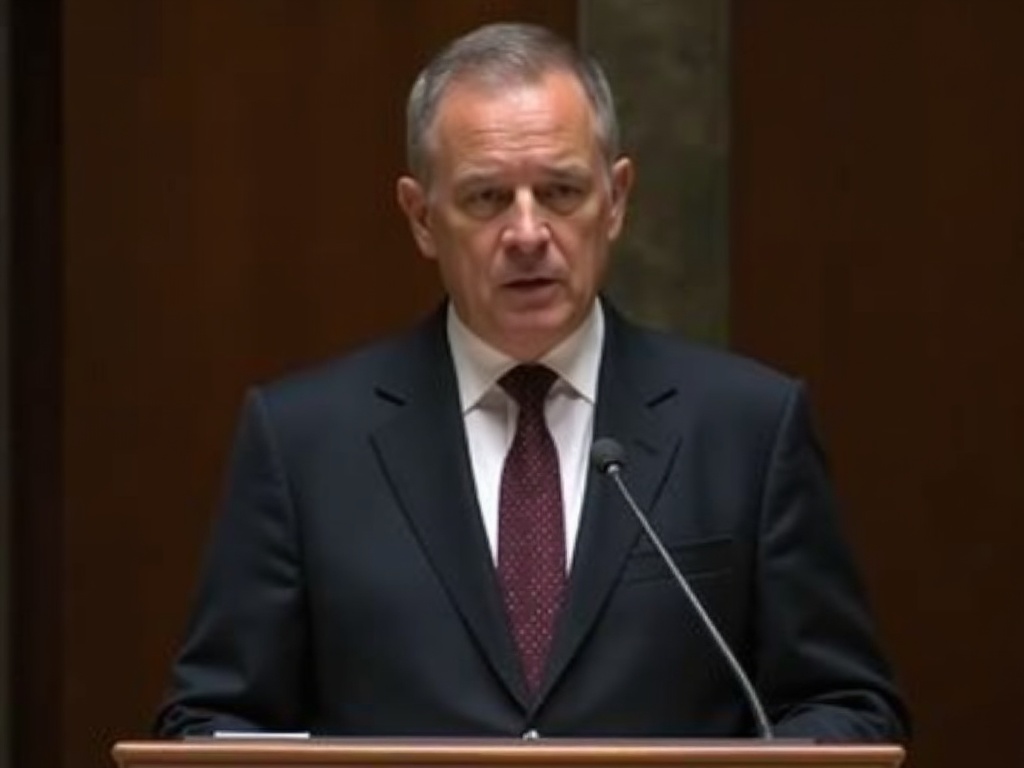
Budapest finds itself at the precipice of a significant political reorientation as Peter Magyar, the newly galvanized voice of Hungary’s opposition, intensifies his challenge to the entrenched establishment. His recent pronouncements—an unequivocal call for the national President’s resignation and a resolute vow to dismantle and reconstruct the nation’s state media apparatus—underscore a burgeoning political movement poised to redefine the country’s democratic landscape. The audacious timeline, suggesting a government formation by mid-May, positions Magyar not merely as a critic, but as a contender for immediate power.
Key Takeaways
- Peter Magyar, a rising opposition figure, has called for Hungary’s President to resign.
- Magyar pledges a complete overhaul of state media, alleging its use as a propaganda tool.
- He projects his government could be formed by mid-May, indicating rapid political ambitions.
- This challenge signals a potential inflection point in Hungary’s democratic trajectory and its relationship with the European Union.
The Imminent Reckoning: Presidential Tenure and Media Control
Magyar’s demand for the President’s departure is not an isolated incident but emerges from a broader narrative of dissatisfaction that has simmered within Hungarian society. This demand, while symbolic, carries considerable weight, challenging the legitimacy of the state’s highest office and signaling a deeper institutional crisis. More substantively, his pledge to fundamentally transform state media strikes at the heart of what many critics, both domestic and international, identify as a critical vulnerability in Hungary’s democratic health: the perceived consolidation of media outlets under government influence. The promise to restore journalistic independence resonates strongly with those advocating for a more pluralistic public discourse, free from partisan editorializing.
Navigating the Labyrinth: Challenges to Entrenched Hegemony
The path to realizing such ambitious reforms is fraught with formidable obstacles. Hungary’s political architecture, meticulously constructed over the past decade, presents an entrenched hegemony that has proven resilient to previous challenges. Magyar’s meteoric rise, largely fueled by a sophisticated digital campaign and massive street demonstrations, indicates a potent capacity to mobilize public sentiment. However, translating this momentum into durable political power and institutional change necessitates navigating complex parliamentary dynamics and confronting a well-resourced incumbent apparatus. The proposed mid-May government formation, while signaling confidence, will require rapid coalition-building or an unexpected electoral breakthrough to materialize.
A Paradigm Shift for Hungarian Democracy?
The potential for a Magyar-led government, particularly one committed to media reform, could herald a significant recalibration of Hungary’s position within the European Union. Concerns regarding the rule of law, judicial independence, and media freedom have long strained Budapest’s relationship with Brussels. A genuine commitment to these democratic principles, championed by a new administration, could pave the way for a more constructive engagement and potentially alleviate sanctions or legal proceedings currently facing the nation. Observers will be keenly watching whether Magyar’s rhetoric can translate into concrete policy shifts that reinforce democratic norms and restore trust in public institutions.
Conclusion
As Hungary anticipates a potentially transformative period, Peter Magyar’s emergence represents more than just a change of political personalities; it symbolizes a profound public yearning for accountability and institutional integrity. The coming weeks, leading up to his ambitious mid-May deadline, will undoubtedly test the resilience of Hungary’s established order and reveal the true depth of the societal forces now propelling Magyar’s reformist agenda.
Leave a Reply