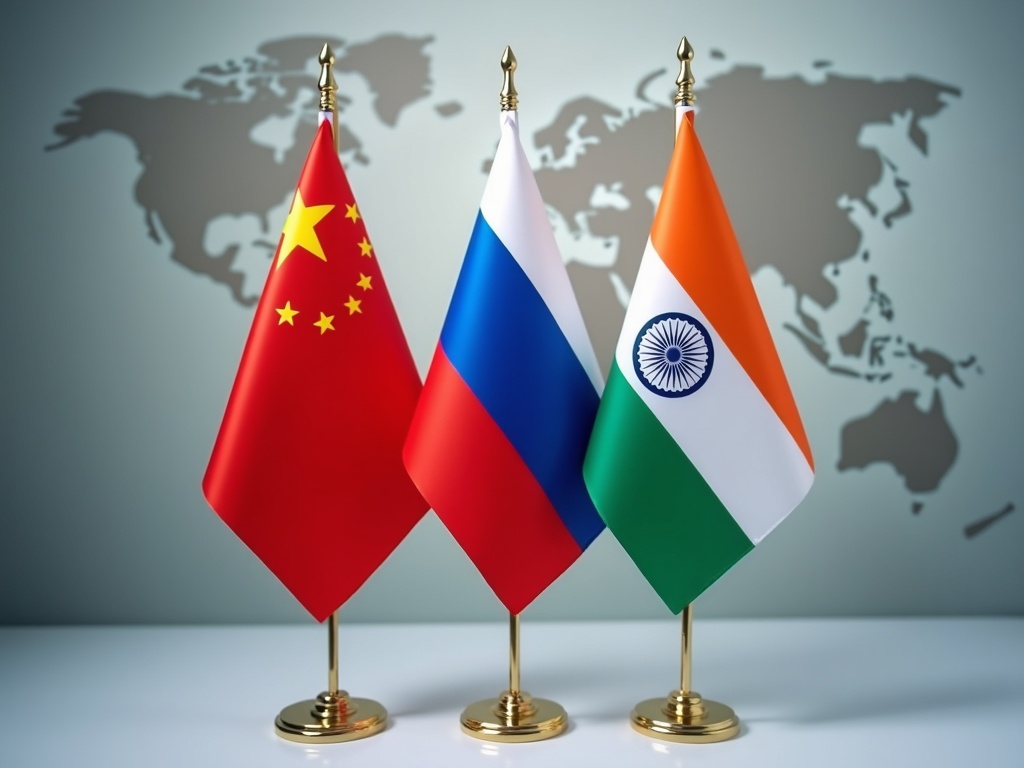
- Ministers from China, Russia, and India convened their 15th trilateral meeting.
- A joint statement affirmed their agreement to maintain regional security and economic architecture in the Asia-Pacific.
- The meeting underscores a collective desire for regional stability and a multipolar global order.
- India’s participation highlights its strategic autonomy, balancing engagement with both Western and non-Western blocs.
- The discussions reflect the deepening strategic alignment between China and Russia in the current geopolitical climate.
In a significant diplomatic convergence, the foreign ministers of China, Russia, and India convened their 15th trilateral meeting on Monday, issuing a joint statement that affirmed their collective commitment to upholding regional security and economic architecture in the Asia-Pacific. The gathering underscores a concerted effort by these three major powers to articulate a shared vision for the dynamic and strategically vital region, amidst evolving geopolitical currents.
The Trilateral’s Enduring Mandate
A Statement of Intent
The joint statement, emerging from the high-level discussions, is more than a mere diplomatic formality; it represents a powerful assertion of a non-Western-centric approach to regional governance. By agreeing to “maintain regional security and economic architecture,” the three nations are signaling their intent to preserve stability through multilateralism and cooperation, implicitly resisting any singular hegemonic influence. This commitment spans various domains, from counter-terrorism and maritime security to promoting open and inclusive trade frameworks, all designed to foster sustainable growth within the Asia-Pacific.
Echoes of a Multipolar World
This trilateral format, often seen as a cornerstone of the broader BRICS and Shanghai Cooperation Organization (SCO) frameworks, gains particular salience in the current global landscape. The meeting reiterates a shared aspiration for a multipolar world order, where diverse centers of power contribute to global stability rather than adhering to a unipolar structure. For Beijing, Moscow, and New Delhi, this translates into fostering an environment where national sovereignty is paramount and external interference in regional affairs is minimized, providing a counter-narrative to traditional Western-led international institutions.
India’s Strategic Calculus: A Balancing Act
Navigating Complex Alliances
India’s participation in the trilateral is a crucial component of its complex and fiercely independent foreign policy. New Delhi consistently champions the concept of “strategic autonomy,” allowing it to engage with multiple power blocs simultaneously. While maintaining robust security partnerships with the United States and its allies through forums like the Quad, India also sees significant value in its long-standing ties with Russia – particularly in defense and energy – and in fostering dialogue with China, despite persistent bilateral border tensions. This approach positions India as a pivotal bridge, capable of influencing diverse geopolitical groupings.
Economic Imperatives and Geopolitical Pragmatism
For India, the trilateral provides a platform to advance its economic interests, including energy security and trade diversification, while also engaging in vital regional security discussions. Its pragmatic approach acknowledges that collaboration with China and Russia on certain fronts is essential for addressing common challenges, ranging from climate change to cross-border terrorism. The discussions likely touched upon infrastructure development, connectivity projects, and frameworks that can enhance intra-regional economic resilience, reducing reliance on traditional Western-dominated financial systems.
The China-Russia Nexus: Deepening Alignment
Post-Ukraine Realities
The meeting also served to underscore the deepening strategic alignment between China and Russia, a partnership that has gained significant momentum in the wake of the conflict in Ukraine. Both nations perceive a shared imperative to challenge what they view as Western dominance and uphold a vision of international relations based on non-interference and state sovereignty. Their “no-limits” partnership manifests in increased energy cooperation, defense technology exchanges, and coordinated diplomatic efforts on various global issues, creating a formidable geopolitical axis.
Shared Vision of Stability
From Beijing and Moscow’s perspective, a stable Asia-Pacific, free from perceived external meddling, is critical for their respective national interests and broader geopolitical objectives. This convergence allows them to advocate for a security architecture that prioritizes regional actors’ agency and promotes dialogue over confrontation. While the statement emphasized broad principles, the undercurrent of reinforcing an alternative global governance framework was unmistakable, positioning the trilateral as a significant forum for coordinating their efforts in this regard.
Challenges and Future Trajectories
Underlying Fissures and Divergent Interests
Despite the joint statement’s harmonious tone, the trilateral is not without its inherent complexities and potential friction points. The unresolved border dispute between China and India remains a significant undercurrent, requiring delicate diplomatic management. Furthermore, while all three nations advocate for multipolarity, their individual visions for regional dominance or influence may not always align perfectly. These underlying fissures necessitate a sustained commitment to dialogue and confidence-building measures for the trilateral mechanism to achieve its full potential.
The Path Ahead
Ultimately, the 15th trilateral meeting serves as a powerful reminder of the ongoing transformation in global power dynamics. While not a formal alliance, the China-Russia-India grouping provides a vital platform for these significant global players to coordinate their approaches to regional security, economic development, and the shaping of a future international order. Its continued evolution will be closely watched as a bellwether for the trajectory of multilateralism in an increasingly fragmented world.
Leave a Reply