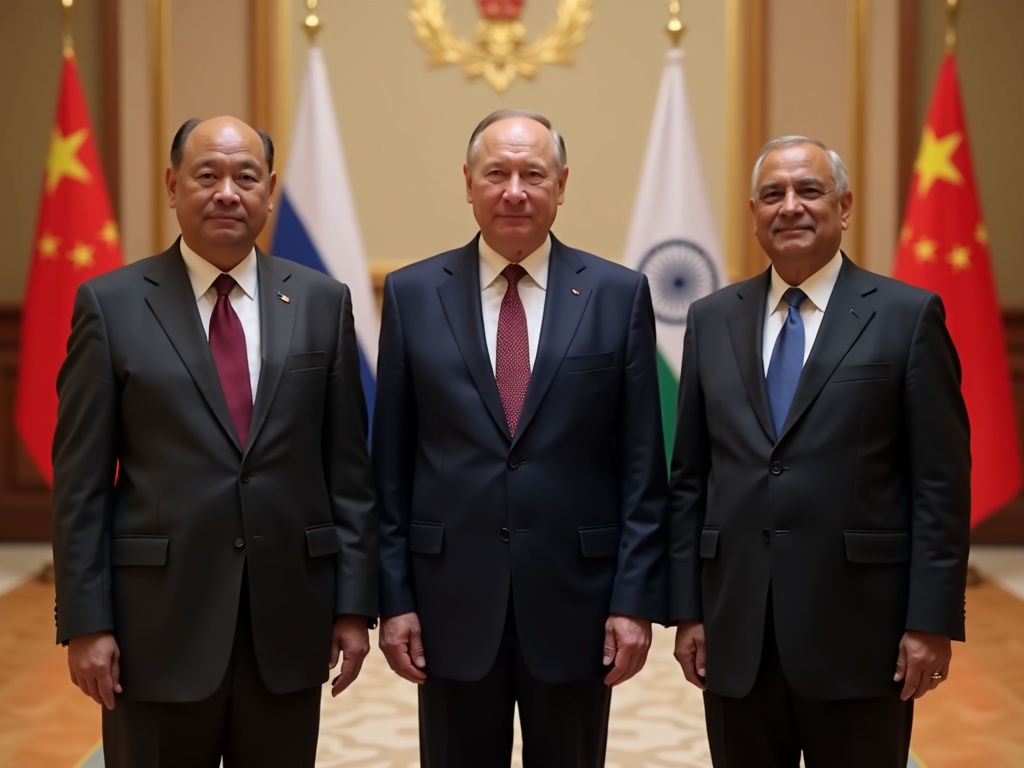
- Foreign ministers of China, Russia, and India (CRI) held their 15th trilateral meeting.
- The nations collectively agreed to uphold the existing regional security and economic framework in the Asia-Pacific.
- The joint statement emphasizes stability and multilateralism amidst an increasingly complex global geopolitical landscape.
- The meeting signals a continued convergence of interests on regional order among the three major powers.
The convergence of three formidable geopolitical players—China, Russia, and India—at their 15th trilateral foreign ministers’ meeting on Monday has sent a clear signal regarding the future contours of the Asia-Pacific. The joint statement, affirming their collective commitment to maintaining regional security and economic architecture, underscores a shared vision for stability amidst a period of profound global realignment.
A Steadfast Commitment to Regional Order
The annual gathering, now in its fifteenth iteration, has evolved into a significant platform for strategic dialogue among Beijing, Moscow, and New Delhi. This year’s communique from the three foreign ministers—Wang Yi, Sergey Lavrov, and S. Jaishankar—was notable for its emphasis on preserving existing regional frameworks rather than advocating for radical shifts. This commitment reflects a common interest in predictable, rules-based engagement, albeit one potentially interpreted through a non-Western lens.
For China, the trilateral serves as a crucial avenue to bolster its vision of a multipolar world, counterbalancing unipolar tendencies and fostering regional cooperation under frameworks like the Shanghai Cooperation Organisation (SCO) and BRICS. Russia, increasingly isolated by Western sanctions, finds in this forum an affirmation of its status as a major global power and a partner in shaping Eurasian security. India, while carefully navigating its deepening strategic partnerships with Western nations, leverages the CRI mechanism to assert its independent foreign policy and maintain crucial ties with both its northern neighbors.
The Architecture of Asia-Pacific Security and Economy
The phrasing “maintain regional security and economic architecture” is pregnant with meaning. In the security domain, it implicitly rejects external interference and unilateral actions that could destabilize the region. This resonates with Beijing’s stance on Taiwan and the South China Sea, and Moscow’s perspectives on European security. For India, it likely pertains to its concerns regarding border stability and maritime security in the Indian Ocean.
Economically, the agreement points towards a preference for an open, inclusive, and non-discriminatory trading system that supports existing supply chains and developmental initiatives. This aligns with China’s Belt and Road Initiative, Russia’s Eurasian Economic Union aspirations, and India’s efforts to enhance regional connectivity. The joint statement subtly underlines a preference for state-led multilateral initiatives over those perceived as exclusive or adversarial.
Editorial Insight: Navigating the New Multipolarity
This trilateral meeting arrives at a juncture where geopolitical currents are visibly shifting. The collective stance of China, Russia, and India represents a powerful, if sometimes incongruous, counterweight to the prevailing Western-centric order. While each nation possesses its own distinct foreign policy objectives and internal dynamics, their shared interest in preventing a unipolar dominance and promoting a more equitable global governance structure provides a robust foundation for this ongoing dialogue.
A critical nuance lies in India’s position. New Delhi has skillfully maintained robust engagement with the Quad (Quadrilateral Security Dialogue involving the U.S., Japan, Australia) while simultaneously participating actively in platforms like CRI and BRICS. This balancing act highlights India’s strategic autonomy and its ambition to be a ‘vishwaguru‘ or global teacher, engaging with all major powers rather than aligning exclusively with one bloc. The joint statement from the CRI meeting thus affirms India’s enduring commitment to multipolar diplomacy, even as its relations with the West continue to deepen.
The long-term implications of such trilateral cooperation are significant. While direct military alliances among the three remain unlikely given their diverse strategic interests and historical baggage, the regularized diplomatic consultations foster a shared understanding of regional challenges. This tacit coordination in international forums could lead to more aligned positions on critical global issues, from climate change to counter-terrorism, and further solidify a non-Western perspective on international law and governance.
Challenges and Future Trajectories
Despite the outward show of unity, inherent challenges persist. The unresolved border issues between China and India, the differing approaches to global governance, and varying degrees of economic integration could test the durability of this trilateral engagement. However, the consistent nature of these meetings for over a decade suggests a pragmatic recognition that shared strategic interests often outweigh bilateral friction.
As the Asia-Pacific continues to be a crucible of geopolitical competition and economic dynamism, the CRI trilateral will undoubtedly play a pivotal role in shaping its future. The commitment to maintaining existing architecture, rather than disrupting it, could be interpreted as a conservative yet strategically vital approach to ensuring stability in a volatile world, positioning these three powers as indispensable architects of a new, multipolar global order.
Leave a Reply