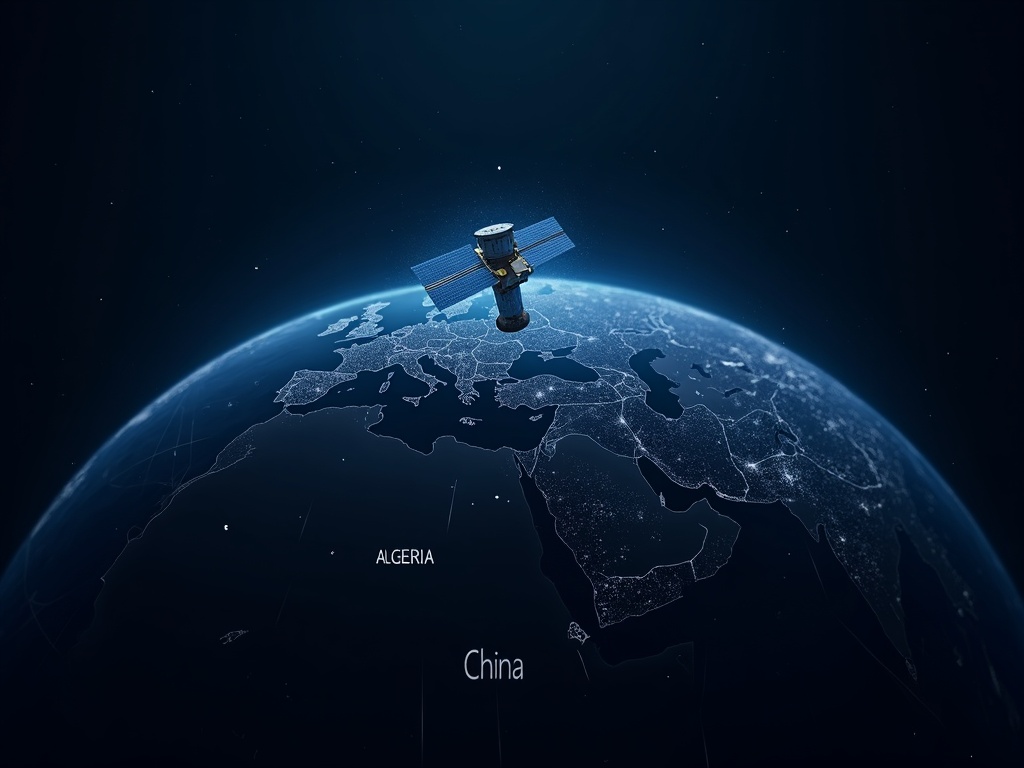
In a significant stride for both its burgeoning space industry and its deepening geopolitical ties, China successfully launched a communications satellite for Algeria on Monday. This event marks a notable first: the inaugural export of a Chinese-made communications spacecraft to an Arab nation, heralding a new chapter in Sino-Arab technological cooperation and underscoring Beijing’s expanding influence in the global commercial space sector.
- China successfully launched the Alcomsat-1 communications satellite for Algeria.
- This marks China’s first export of a communications satellite to an Arab country.
- The launch signifies a major advance in China’s commercial space export capabilities.
- It deepens technological cooperation between China and Arab nations, aligning with China’s ‘Digital Silk Road’.
- For Algeria, the satellite enhances national communication infrastructure and digital sovereignty.
Geopolitical Orbits: China’s Expanding Space Footprint
The successful launch of the Algerian satellite, named Alcomsat-1, from the Xichang Satellite Launch Center is more than a mere technical achievement; it represents a strategic pivot in the landscape of international space partnerships. For years, Western nations, predominantly the United States and European consortia, have dominated the commercial satellite export market. China, leveraging its state-backed aerospace capabilities and competitive pricing, is now asserting itself as a formidable alternative, particularly for nations seeking advanced technology without the geopolitical conditionalities often associated with traditional suppliers.
This initiative aligns seamlessly with China’s broader Belt and Road Initiative (BRI), particularly its ‘Digital Silk Road’ component. By providing critical space infrastructure, Beijing not only fosters goodwill and economic interdependence but also establishes long-term technological dependencies that strengthen its strategic position. The export of a sophisticated communications satellite demonstrates China’s comprehensive capabilities, offering an end-to-end solution that encompasses design, manufacturing, launch services, and potentially, ground segment support and operational training. This integrated approach presents an attractive package for developing nations keen on rapid technological advancement and digital sovereignty.
Algeria’s Strategic Imperative in the Digital Age
For Algeria, the acquisition of Alcomsat-1 is a profound step towards enhancing its national communications infrastructure and reducing reliance on foreign networks. The satellite is poised to play a crucial role in providing internet connectivity across remote and rural areas, improving telecommunications, broadcasting, and disaster management capabilities. In a nation of over 44 million people, with diverse topography, reliable and secure domestic communication is paramount for economic development, social inclusion, and national security.
This collaboration also underscores Algeria’s strategic hedging in a multipolar world. As a significant player in North Africa and a key energy exporter, Algeria seeks to diversify its partnerships and strengthen its technological autonomy. The choice of China as a space technology partner reflects a pragmatic decision to access cutting-edge capabilities that might be more readily available or align better with its developmental objectives than those offered by other global powers.
Sino-Arab Ties: A New Horizon for High-Tech Collaboration
The Alcomsat-1 project sets a significant precedent for future high-tech cooperation between China and other Arab nations. Many countries in the Middle East and North Africa are actively pursuing ambitious digital transformation agendas, investing heavily in smart cities, e-governance, and advanced communication networks. China, with its proven track record in telecommunications infrastructure, artificial intelligence, and now, commercial space technology, is uniquely positioned to become a preferred partner in these endeavors.
Beyond Algeria, states like Saudi Arabia, the UAE, and Egypt have already engaged in various forms of space collaboration, albeit often with European or American partners. This new benchmark with Algeria signals China’s readiness to become a primary provider of critical space assets to the entire Arab world, potentially reshaping regional technological alliances and creating a more competitive global market for satellite services.
The successful launch for Algeria is therefore not just a technical footnote but a powerful signal of China’s growing stature as a global technology exporter and a strategic partner. It illustrates a nuanced shift in global power dynamics, where technological prowess is increasingly intertwined with geopolitical influence, opening new avenues for cooperation and competition in the cosmos and on Earth.
Leave a Reply