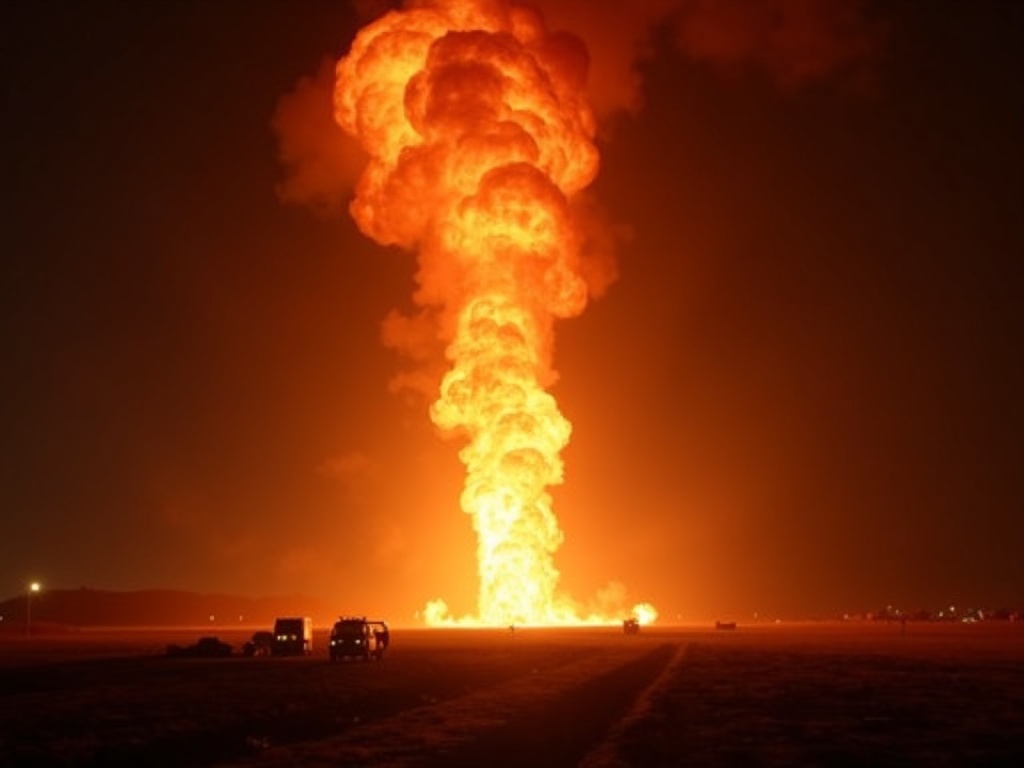
HARIPUR, Khyber Pakhtunkhwa – A devastating gas line explosion in Pakistan’s Hattar Industrial Estate has resulted in the deaths of at least eight individuals, including children, and left eleven others injured. The incident, involving a Sui Northern Gas (SNGPL) supply line, occurred near a factory, igniting a ferocious blaze that underscored pressing concerns about industrial safety protocols and infrastructure integrity in rapidly developing regions.
Key Takeaways
- Fatalities and Injuries: Eight people, including children, confirmed dead; eleven others sustained injuries.
- Incident Location: Hattar Industrial Estate, Haripur district, Khyber Pakhtunkhwa.
- Cause Under Investigation: The exact cause of the gas line burst and subsequent fire remains undetermined, with investigations underway.
- Suspected Cause of Death: Haripur Deputy Commissioner Waseem Ahmed indicated that suffocation appeared to be the primary cause of fatalities.
- Infrastructure Details: A 16-inch diameter SNGPL supply line, serving industrial estates up to Abbottabad, was involved, located near 400 residential quarters.
- Rescue Operation: SNGPL, Rescue 1122, and other emergency services worked for approximately two to three hours to control the blaze.
- Potential Factors: Hypotheses include chemical leakage from nearby factory godowns or an explosion due to gas pressure.
The Unfolding Catastrophe in Hattar
The incident unfolded around 6:30 PM, when area residents reported a “gas explosion and large fire” to SNGPL. Field teams, upon arrival, found a significant portion of the 16-inch diameter pipeline engulfed in flames. This critical supply line, a vital artery for industrial gas distribution stretching north towards Abbottabad, tragically lies in close proximity to 400 residential quarters within the Hattar Industrial Estate, immediately exposing hundreds to grave danger.
Dr. Munawwar Afridi, from the Haripur District Headquarters Hospital (DHQ), confirmed the tragic human toll, stating that three bodies were brought to the DHQ and an additional five to the Rural Health Centre (RHC) in Kot Najibullah union council. Haripur Deputy Commissioner Waseem Ahmed, who oversaw the extensive firefighting and rescue operation alongside District Police Officer (DPO) Shafiullah Khan, posited that suffocation was the likely cause of death for most victims. Several nearby houses were also affected by the intense heat and flames radiating from the burst pipeline.
Challenges in Containment and Emerging Questions
Muhammad Amir, an official from SNGPL, detailed the arduous efforts to douse the inferno. Despite cutting off the gas supply to the ruptured line, rescue personnel from SNGPL, Rescue 1122, and local fire departments faced significant difficulties for at least two hours due to the sheer volume of residual gas still burning. The intensity of the blaze was such that flames were reportedly visible from kilometres away, painting a stark, terrifying picture against the evening sky.
The exact cause of the catastrophic failure remains under rigorous investigation. Amir speculated on potential factors, suggesting that the supply line’s proximity to factory godowns containing chemical materials could mean a “leakage could have caused the fire.” DPO Khan, while awaiting forensic analysis, noted that “circumstantial evidence showed that gas pressure could have caused an explosion in the supply line.” These preliminary hypotheses underscore a disturbing convergence of potential hazards in an industrial setting.
Broader Implications and the Path Forward
This tragic event in Haripur serves as a stark reminder of the inherent vulnerabilities in Pakistan’s industrial infrastructure, particularly where economic development and population density intersect. The proximity of a high-pressure gas supply line to residential quarters within an industrial estate highlights critical deficiencies in urban planning, zoning regulations, and safety buffer zones. For ‘The Peking Brief’, this incident warrants an examination of regulatory oversight – specifically, whether existing safety standards for high-risk industrial installations are adequately enforced and updated, especially concerning pipelines that traverse or are adjacent to densely populated areas.
The call for a comprehensive and transparent investigation is not merely about assigning blame but about formulating robust preventative measures. It necessitates a thorough audit of similar gas supply lines across industrial zones, an assessment of emergency response preparedness, and a review of building codes and urban planning directives to ensure the safety of communities living on the periphery of industrial development. The human cost of this tragedy demands an unwavering commitment to fortify infrastructure resilience and prioritize public safety, lest such avoidable catastrophes recur.
Leave a Reply