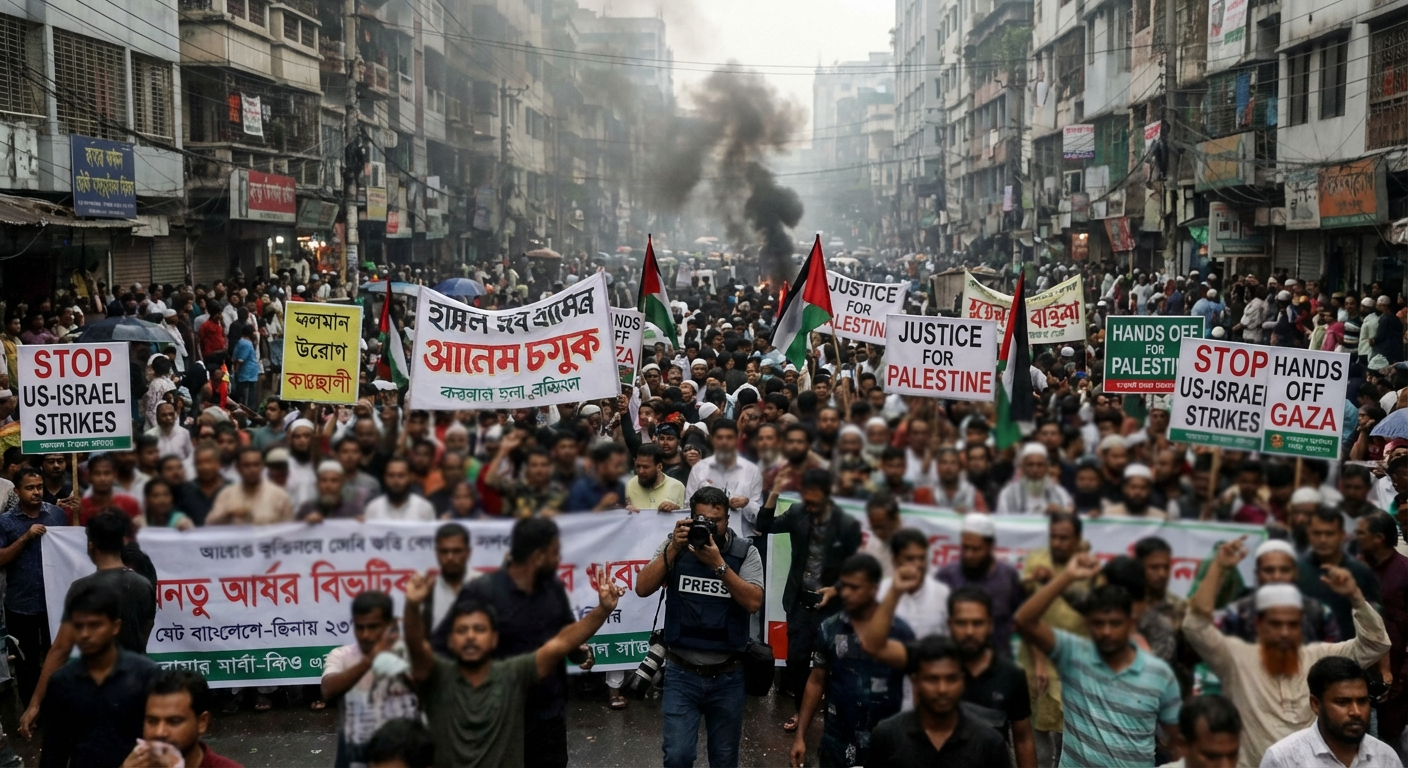
ISLAMABAD – Widespread protests have broken out across South Asia following reports of airstrikes in Iran and the escalating conflict between the United States, Israel, and Tehran. Demonstrators took to the streets in major cities across Pakistan, India, and Bangladesh, voicing strong opposition to the military actions and calling for immediate international intervention.
Public Outcry
In Pakistan, thousands gathered in Islamabad and Karachi, waving flags and chanting slogans condemning the violence. The protests, organized by various political and religious groups, remained largely peaceful, though isolated incidents of clashes with police were reported. “We cannot remain silent while our neighbors and brothers suffer,” said one protest leader in Lahore.
Similarly, in Indian-administered Kashmir, protests erupted in Srinagar, with demonstrators marching through the city center. Security forces were deployed in large numbers to maintain order. The sentiment across the region reflects deep-seated concerns over the humanitarian impact of a wider war in the Middle East.
Regional Impact
The unrest is not limited to street demonstrations. Governments in South Asia are bracing for the economic fallout. The region relies heavily on oil imports from the Gulf, and any disruption to supply lines could have devastating effects on already fragile economies. Pakistan, facing its own economic challenges, has expressed grave concern over the potential for skyrocketing fuel prices.
Furthermore, millions of South Asian expatriates work in the Gulf states. Their safety and the flow of remittances, a vital economic lifeline, are now at risk. “We are worried about our families in the UAE and Saudi Arabia,” said a Bangladeshi worker in Dhaka. “If the war spreads, what will happen to them?”
Government Responses
Official responses from South Asian capitals have been cautious but firm. Pakistan’s Foreign Ministry issued a statement urging “maximum restraint” and calling for a diplomatic solution. India, while maintaining strategic ties with both the US and nations in the region, has also called for de-escalation, emphasizing the need for stability in West Asia.
As the conflict unfolds, the streets of South Asia serve as a barometer for public sentiment in the Muslim world and beyond. The pressure on local governments to take a stronger stance is likely to grow if the violence continues to escalate.
Leave a Reply